
.jpg)
It’s no surprise that energy generation and everything power related has been THE focus for Climate VC (and every other investor under the sun) for the last couple of years, and we’ve been paying close attention at DSV. Well, we’re excited to ‘announce’ that we’re partnering with a very well known transatlantic utilities company to launch a venture targeting transmission infrastructure, and that as part of this, we’re hiring a Founder-in-Residence! Read on to see how we’re thinking about the space.
The soaring demand for power
Meeting demand means roughly tripling grid capacity by 2050 [ref]. In practice that means building high-voltage transmission about ten times faster than the US ever has; close to 5,000 miles a year, against a historical average nearer 500 [ref]. Right now it’s going the wrong way, with 402 miles energised in 2025, down from 906 the year before [ref]. The drivers are reshoring, the electrification of industry, and data centres that on their own could be 7 to 12% of US electricity demand within a few years [ref]. Building that much, that fast, is hard. Building it without sending bills through the roof is even harder.
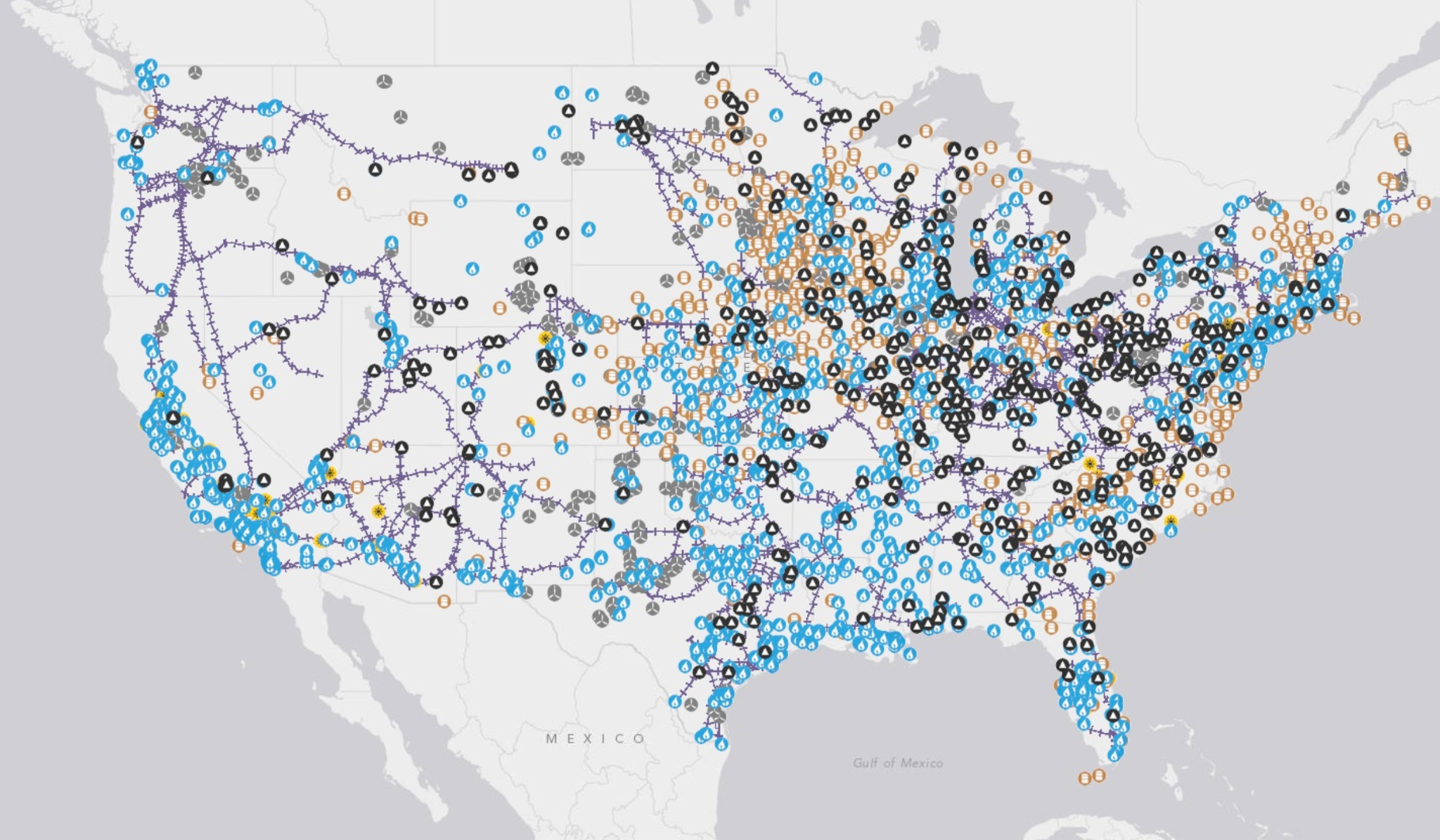
Figure 1: The scale of the transmission challenge [Ref]
Transmission is paid for through regulated tariffs, so every pound of capital is recovered from customers, with a return, via their electricity bills [ref]. Rates across Pennsylvania, New Jersey, and Maryland have roughly doubled in a decade, and transmission now accounts for 10% of a residential bill in Maryland [ref]. The same cost raises the price of everything we're trying to electrify, from heat pumps and EV charging to electrolysers and e-fuels, which erodes the case for switching to them in the first place [ref].
Construction itself is also getting steadily more expensive. New US transmission now averages $3.95m per mile, around double the real, inflation-adjusted cost in 2008 [ref]. Interestingly, no single line item explains the rise. Materials and procurement contribute 20 to 45% of a project, civil works and foundations 10 to 20%, tower erection another 10 to 20%, and the rest is spread across stringing, logistics, project management, financing, and contingency.
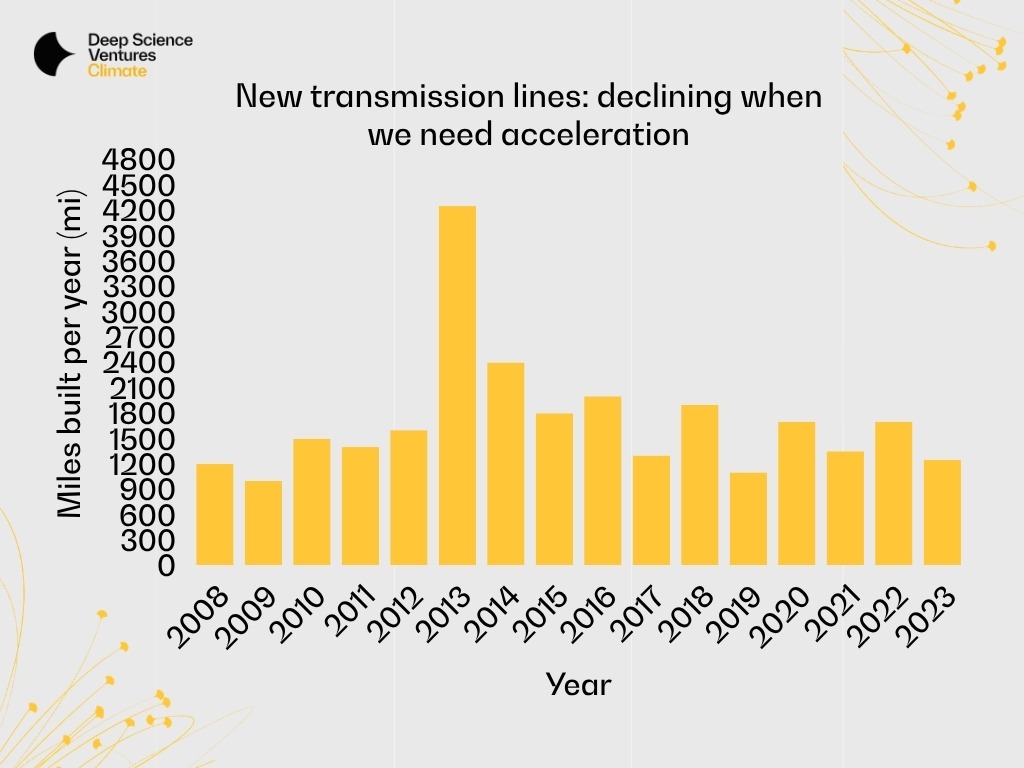
Figure 2: C Three Group [ref]
Some of this is supply chain related: Demand has stretched lead times to extremes, with large power transformers now averaging 128 weeks, and their prices up 40 to 60% since the start of 2022 [ref]. Grain-oriented electrical steel, with Cleveland-Cliffs the sole US producer, is also up around 20% [ref].
Time also plays a role, which turns into cost through financing. Allowance for Funds Used During Construction accrues on capital already spent, at 7.5% a year in MISO's case [ref]. Because that spend ramps up across the build rather than landing on day one, the charge compounds on a growing balance: a six-year construction period adds 19 to 22% to the final cost, against 12 to 14% for a four-year build. Shortening the schedule, on its own, saves money.
Because cost is spread relatively evenly, trimming any single category barely moves the total. The savings come from approaches that can target several categories at once.
Decomposing the problem space
At DSV, we start with the outcome we’re trying to achieve and work backwards from first-principles through the causal logic, until we reach the root constraints that prevent it being true today. We call the result an Outcomes Graph and it helps us to identify potential approaches/solutions, from which we could create ventures. The outcome we’re trying to achieve here is lowering the total installed cost of new high-voltage AC transmission by at least 20%.
Contributing to this Outcome are four potential levers:
1) Can we reduce how much a project physically needs?
2) Can we reduce what each input costs
3) Can we reduce how long it takes to build?
4) Can we reduce how much risk gets priced in?
We triaged projects through that lens, alongside interviews with UK and US utility engineers and our partner's own validation, and one group of approaches stood out as the most promising: Modularity and fragmentation. We were shocked to learn that almost every tower and foundation on the grid is a bespoke design, engineered for its specific span and soil - there might be potential to tackle many cost line items at once, either through standardisation of multiple components, or through single innovations.
Restringing conductors, the cables that actually carry the current, are a good example of a single innovation that has resulted in significant improvements to the grid: American Electric Power restrung 120 miles of 345kV line with novel high-temperature, low-sag conductors, doubling capacity while cutting losses by 30%, and finished eight months early by keeping the line energised throughout, saving $43m [ref]. Reconductoring is now the proven lever for adding capacity to existing lines.
The more interesting frontier is construction itself: Infravision is stringing line by drone, already across more than 2,000 miles and up to 765kV [ref], and Hyperion Robotics and National Grid have trialled 3D-printed substation foundations [ref]. Both are targeting the labour and civil-works costs that conventional methods traditionally treat as fixed.
Where we think the opportunity is
Beyond those examples, we think there are additional opportunities to tackle multiple cost centres at once.
With the structure itself, it might be possible to replace the bespoke steel lattice with a modular, design-for-assembly system to drastically reduce the bill of materials and the on-site labour together, whether through novel interlocks and kit-of-parts or something closer to in-situ printing.
Within foundations, can we standardise designs across messy, variable ground to remove cost and schedule risk at the same time.
Going beyond amendments to existing structures, can we leverage automated and robotic construction to reduce labour input and assembly schedule, either through self-assembly or operator-assistance.
The strongest version of this venture will almost certainly combine more than one of these.
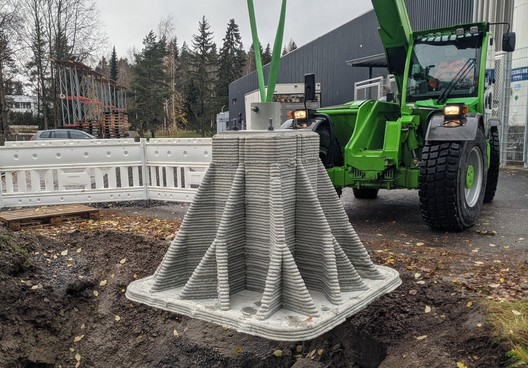
Figure 3: 3D Printing with Low-Carbon Concrete [Ref]
Work at DSV
We're hiring a Founder-in-Residence to work with us to build this venture. We want someone who has seen this problem up close, from transmission design or an adjacent heavy industry, who thinks from first principles and is willing to challenge the whole approach rather than optimise inside it. More details can be found in the job description, linked here.
You'd be the founder, backed by our 15-person team of scientists and engineers, most with a STEM PhD, a venture-backed company behind them, or both, drawing on a process we've used to build more than 60 companies from nothing. We don't pull IP out of labs, we’ll create it together, and we don't expect you to arrive with a fixed thesis. Our utility partner stays close throughout, bringing operational depth across regulated and unregulated markets in the UK and US. Over 12 to 18 months you'd narrow the problem to the most ventureable approach, build the technical and commercial proof, recruit your founding team, and spin out with investment.
If that sounds like you, apply through the job description linked above - we look forward to hearing from you!