
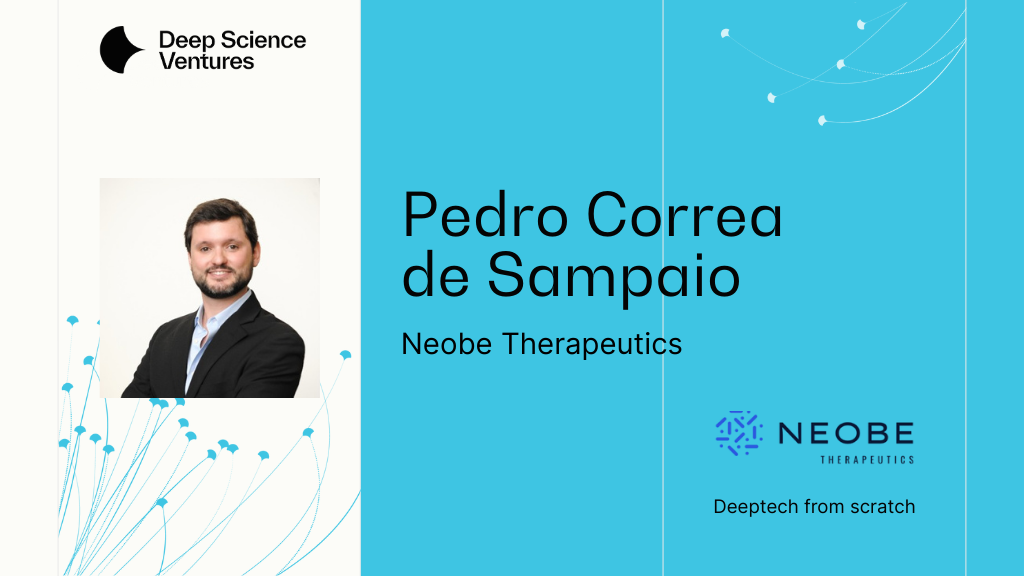
Here comes #3 of our podcast series, exploring the often-messy, sometimes-brilliant, and always-audacious journeys of founders tackling the world’s hardest problems. Each profile is released as a podcast episode alongside an accompanying article.
In this, our third episode, we get into it with Neobe Therapeutics. Founded by Pedro Correa de Sampaio and Annelise Soulier, they have set out to dismantle the physical walls of solid tumours using engineered bacteria. To find out how they are using synthetic biology to turn microbes into biological bulldozers that unlock the efficacy of cancer immunotherapies, you can listen to the full interview with Pedro here:
Deeptech from scratch #3, with Pedro Correa de Sampaio, Co-founder & CEO, Neobe Therapeutics:
Most cancer treatments face a literal wall. While the world celebrates breakthroughs in CAR T-cells and precision immunotherapies, these drugs often fail for a frustratingly simple reason: they cannot actually get inside the tumour.
In the latest episode of the DeepTech From Scratch podcast, Kerstin Papenfuss, our Director of Pharma, sits down with Pedro Correa de Sampaio, Co-Founder and CEO of Neobe Therapeutics. They trace the journey of Neobe from a serendipitous meeting over manatees to building a company that turns bacteria into biological bulldozers capable of dismantling the physical barriers of cancer.
The Wall of Solid Tumours
In cancer research, the focus is often on the transformed malignant cells. However, as Pedro explains, the tumour microenvironment is often more dangerous than the cancer itself.
Solid tumours are not just clumps of rogue cells; they are protected by the stroma, a dense, fibrotic scaffolding that acts like a fortress wall. This physical barrier creates high interstitial pressure, preventing drugs and immune cells from penetrating the deep-seated castle of the tumour.
Historically, trying to break down this wall was toxic. The components of the tumour wall, such as collagen and hyaluronic acid, also exist in healthy skin, heart, and lungs. If you give a patient a drug to dissolve the wall, you risk dissolving the patient.
Why Bacteria?
When DSV and Pedro began the process of scoping this problem, they applied a first-principles approach. They did not start with a specific technology; they started with a set of constraints. They needed to break down the stroma specifically inside the tumour to avoid systemic toxicity, using a delivery vehicle that could penetrate where other cells could not.
The answer was engineered bacteria.
Unlike human cells or nanoparticles, certain bacteria are naturally drawn to the low-oxygen environments inside tumours. By using synthetic biology, Neobe engineers these bacteria with genetic circuits. These circuits act like a lock and key: the bacteria only activate and begin secreting wall-dissolving enzymes once they are safely colonised inside the tumour.
From Shipping Containers to Curative Data
The journey of Neobe is a testament to the Deep Science Ventures model. Pedro moved from a postdoc in the US back to his childhood bedroom in Lisbon during the 2020 lockdowns, building the company’s foundation over Skype.
Eventually, he moved to London, found his Co-Founder Annelise Soulier, and began running experiments in a lab that was an adapted shipping container behind Shepherd's Bush Market. Today, those early days have evolved into a sophisticated platform generating data that Kerstin describes as unlike anything she has seen in her career, including curative effects in tumours that previously resisted all treatment.
The Road to 2026 and Beyond
As Neobe enters 2026, the focus has shifted toward clinical impact. Despite a difficult period for biotech investment, Neobe’s resilience has seen them through. They are currently closing their Seed round to fund the leap into first-in-human clinical trials by late 2027.
The company’s name, a blend of Neo and Microbe, is a nod to both their biological platform and the film The Matrix. Like the character Neo, these engineered microbes are designed to see through the code of the tumour and break it from the inside out.
Any investors or manatee supporters looking to join the journey should reach out Pedro now before the round closes this March.