
.png)
The key is building an economy where the rainforest is worth more alive than dead.
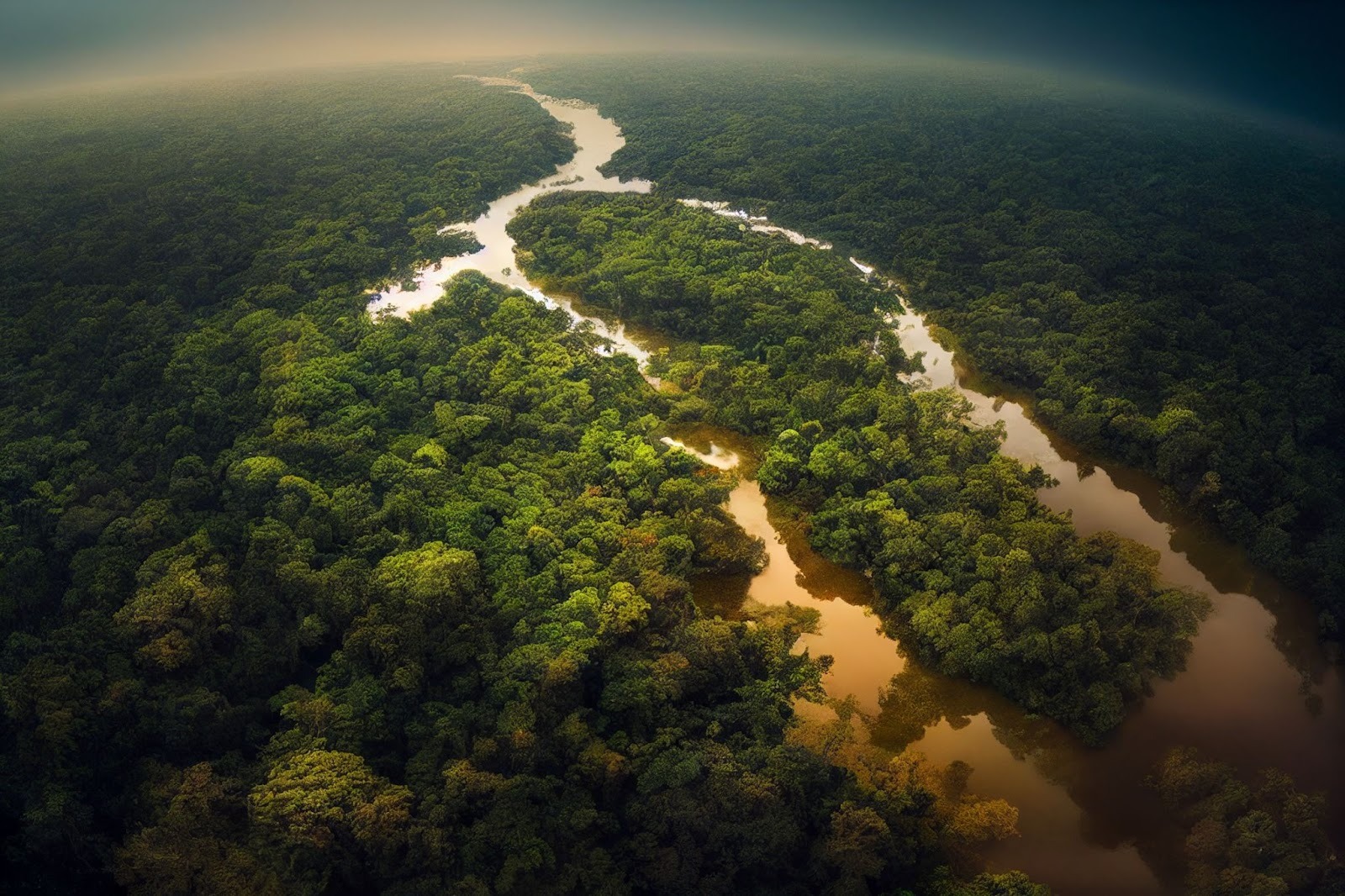
Off the back of COP30, much of the attention has centred on how to halt deforestation in the Amazon. Nearly 80 million hectares of forest have already been lost, and between 2001 and 2020 deforestation continued at an average of 2.7 million hectares per year. To disrupt the financial incentives driving this trend, Brazil is spearheading the Tropical Forest Forever fund - an effort to raise $125bn for investment in bonds, distributing returns to countries and communities that successfully conserve standing forests.
But as the threat of Amazon dieback intensifies under climate change, conservation alone is no longer sufficient - we must actively rebuild the rainforest. Researchers estimate that at least 80% forest cover is required in the Amazon to be resilient against dieback (ref). This means restoring 27.5 million hectares of forest - an area roughly the size of the UK - in a manner that incorporates water recycling and hydrological-climatic functions that underpin system-wide resilience. If we fail to do this, the forest may lose its ability to recycle moisture and recover from droughts and fires, turning into a dry, open-canopy savanna.
This would transform the Amazon from a carbon sink into a carbon source, raising global CO₂ by ~23 ppm, equivalent to every car on Earth running for 26 years. It would also generate severe climate impacts across the continent, from the Amazon itself to South-East Brazil, Paraguay and Argentina, where the rainforest functions as a critical rainfall engine. The resulting food insecurity, infrastructure damage and health risks could lead to an estimated loss of US$256 billion in regional GDP and over 1 billion disability-adjusted life years this century.
There is no debate over the urgency of this challenge, but still only ~100,000 hectares in Brazil are currently under active restoration (ref), and project failure rates in the Tropics can range from 30-70% (ref, ref). We must accelerate restoration, and while funding provides one lever for this; innovation provides the other. It is unacceptable that up to half of replanted trees fail to survive in the tropics (ref), with strategies that ignore the livelihoods and security of local communities (ref) and fail to deliver promised long-term environmental outcomes (ref).
At Deep Science Ventures, we see the opportunity to reduce cost and improve success rates so that exponentially more land is restored in alignment with forest stability and function. High-integrity agroforestry offers the pathway to do so - integrating native trees, crops and communities into a single approach that restores degraded landscapes, enhances biodiversity, stores carbon, improves soils and generates livelihoods. Taking this approach, we can restore forest cover above the resilience threshold and lock in durable economic incentives for both human and planetary thriving.
While many organisations are already advancing this field, critical gaps remain for agroforestry to scale in a sustainable and investable way. Deep Science Ventures, working together with Renaissance Philanthropy to create the Climate Emergencies Resilience Lab and now in partnership with impact investor IMPAQTO Capital, have honed in on the following opportunities that need to be solved for:
Planning and investment
Agroforestry is stuck in a ‘pilot trap’ because investors can’t reliably price risks. Real projects show ~50% of agroforestry plots generating cash income after a decade of operation. Improving success rates and solving uncertainty is essential to unlock the multi-billion finance gap for Amazon restoration.
Land suitability: Approaches to identifying which degraded lands are actually suitable for large-scale agroforestry remain rudimentary. Building predictive models that leverage hydrology, soil, microclimate and socio-economic data can enable identification of priority ‘restoration-ready’ zones and then guide the project designs to be optimised for long term forest resilience.
Land tenure: Unclear land rights remain one of the biggest blockers for long-term agroforestry, especially for investors and lenders. A platform combining geospatial analysis, lightweight legal verification, and tenure ‘risk scoring’ could unlock access to credit and reduce project failure risk.
Cashflow: A major barrier to agroforestry adoption is the 3-5 year gap before farmers see meaningful returns, and the absence of standardised frameworks for assessing agroforestry performance and collateral value. A cashflow accelerator providing advance payments or revenue-based financing, underwritten by remote sensing with bespoke yield tables and growth indices that track early-stage project success probabilities, could dramatically de-risk adoption. This makes agroforestry investable at scale while directly tying financial incentives to reforestation outcomes.
Implementation
Even when capital is available, scaling agroforestry can break on unit economics. Published agroforestry budgets in Brazil put establishment at ~$11,000/ha with large shares in maintenance / labour and planting material. Moving from hectares to landscapes demands improved inputs and deployment systems that drive costs down and reliability up.
Inputs: Seedlings and inputs represent the largest cost in agroforestry development, and access to native, locally adapted species is a major bottleneck. Emerging technologies - including modular propagation protocols, adaptive culture media and tuneable somatic embryogenesis - could underpin agroforestry bio-factories capable of producing climate-resilient clones at scale. This could reduce input costs by up to 10x and additionally enable reliable production of native species with valuable biochemistries, opening high-value markets in pharmaceutical and cosmetic sectors.
Extension services and labour: To develop a skilled workforce that delivers agroforestry at scale, service models where companies design and implement agroforestry systems over the first 2-5 years in collaboration with landowners could concentrate skilled expertise in a more repeatable model. Learning from regenerative agriculture (e.g. Agrivi, Rhiza), this could also be complemented with offline-first digital apps for remote training and extension services. In parallel, input solutions such as pioneer tree species with fast canopy closure to suppress weeds and biostimulants to enhance survival, could draw down significant hidden labour costs.
Supply chains and market:
The agroforestry opportunity is massive but stranded. If properly connected to buyers and processors, mature cocoa agroforests can generate upwards of ~$1,750/ha/year profit versus ~$50–100/ha/year for extensive cattle ranching. However, fragmented logistics, weak offtake, and low local value-add prevent most producers from capturing that per-hectare upside.
Supply chain consolidation: Connecting multiple agroforestry outputs to markets could be solved by coordinating value chains through digital platforms that aggregate logistics and infrastructure - storage hubs, transport modes, load pooling, cold chain capacity - to optimise the economics of product supply.
Marketplace creation: While inconsistent product demands discourage farmers from transitioning to agroforestry, a guaranteed-buyers marketplace that aggregates demand, standardizes contracts, and provides price transparency could stabilise cashflows and link producers to high-integrity supply chains.
Product processing: Decentralised pre-processing could simplify supply chains by focusing on a smaller range of high value products. For example, export-grade cosmetic and nutraceutical oils present a $59bn market with products that enjoy extended shelf life and up to 10x price uplift over raw seeds. Emerging technologies such as modular supercritical CO₂ processing systems could enable efficient, standardised extraction in remote regions and unlock new Amazon bio-economies.
-
-
In our first phase of work we will establish up to three companies that can synergistically address the toughest barriers to scaling agroforestry. The opportunity is huge: by aligning innovation, finance and entrepreneurship around forest resilience we can transform the Amazon from a system at risk of catastrophic dieback into an engine that supports both human and planetary thriving. Reach out at will@dsv.io if you’d like to learn more or get involved in the coalition we’re building.
—
PARTNERS
Renaissance Philanthropy build thesis-driven philanthropic funds, applying scientific rigour to enable philanthropists and foundations to support transformative ideas that advance entire fields forward.
Deep Science Ventures contributes a proven model for building science-led companies to solve system-level challenges, including prior work with stakeholders in LATAM through their Tropical Agriculture & Bioeconomy Initiative.
IMPAQTO Capital brings proximate capital with deep networks across Ecuador, Peru, Colombia, and Bolivia, long-standing relationships with smallholder farmers and producer associations, and hands-on experience structuring and deploying capital in frontier contexts.
Together, this combination enables us to design companies that are not only technically sound and investable, but also trusted, adoptable, and scalable in the landscapes where agroforestry must succeed.